
Your Content is Killing Your Conversions - If You’re Like Most Businesses
“I’m curious to hear your Top of Funnel approach.”
It was a simple enough question from a C-Suite leader during a first interview I once had.
But it was telling.
Not because top-of-funnel isn’t important… but because the way most businesses think about it creates a blind spot that quietly poisons everything downstream.
Most leaders want to be “methodical” about where they invest budget and resources. That’s fair. The problem is: it’s incredibly hard to prove the revenue impact of awareness.
And when you can’t prove impact, you get anxiety.
When budgets get built, that anxiety turns into contention.
If you Google “revenue-generating OOH campaigns,” even Google kind of shrugs. And if you pull up your GA4 report for organic social referrals, you’re not going to feel inspired either.
So the conclusion becomes tempting:
“We can’t measure awareness well… so we should invest less in it.”
“Attribution is pointing us toward safer bets.”
That decision feels rational.
It’s also how a lot of businesses accidentally build a funnel that gets more expensive every quarter.
You can’t see the value of awareness clearly, so it either gets cut, or you try to force top of funnel efforts to become more sales oriented.
When you cut it, your performance marketing efforts still “work.”
It just costs more. And there is no one telling you that, including your paid media agency.
And the team ends up chasing a problem they created: rising Cost per Acquistion (CAC), falling conversion rates, and “we need more leads” panic.
The biggest content mistake is expecting it to sell
Most brands create content with one of two goals:
Push a brand message
Push a sales message
Either way, the content becomes invisible.
Why? Because the landscape is a street fight for attention, and attention isn’t earned with “promote/support/amplify/push” energy. Those inputs create outputs that look like advertising… and people scroll past advertising.
Highly regarded marketing strategist Neil Patel nails the problem in one line:
“If your organic posts aren’t going at least somewhat viral, your account is basically invisible.”
That’s the trap.
And when content gets scrolled past, it doesn’t just fail at “awareness.”
It fails at something more consequential:
It fails to create interest. Interest shows up as ‘hand raisers’ that took an action like watching a video or visiting your website.
No interest = no hand-raisers.
No hand-raisers = no retargeting fuel.
No retargeting fuel = your “conversion” marketing has to work harder (and gets more expensive).
This is why I keep coming back to the same idea from my last post:
Distribution is earned. And when you earn it, performance marketing gets easier.
Content’s real job: create hand-raisers, not buyers
The strongest top-of-funnel content doesn’t try to close.
It tries to earn attention—and create a measurable pool of interested people you can follow up with.
When people engage with a post, watch a video, or visit your site, they raise their hand… and those hand-raisers become retargeting audiences you can deliver ads to.
That’s not theory. It changes conversion outcomes.
Engaged audiences convert differently (by an order of magnitude)
In a past job, we were able to measure that season ticket leads that were generated through a digital journey that typically started with content and ended with a website form-fill, converted 20x higher than leads from people who did not go through that journey (ie: street team activations, sweepstakes entries, etc.).
Same sales team. Same product. Completely different lead quality, because the journey created (or didn’t create) interest.
That’s the entire point:
Content isn’t there to sell. It’s there to qualify.
So when brands don’t earn attention, organic looks like a waste.
Then they shift budget into paid.
And Patel calls out the downstream consequence: more dependency on ads, and a world where costs keep rising.
But there’s a better model:
Use organic and website content to earn attention and create measurable intent pools… then let performance marketing do what it does best: convert.
The clearest proof lives in retargeting performance
Here’s the version of top-of-funnel impact I trust most:
Not “did this post drive purchases today?”
But:
Did it create hand-raisers?
Did those hand-raisers make our retargeting audiences bigger?
Did conversion rates and CAC improve when we retargeted them?
That’s why I consider digital content the best form of top-of-funnel marketing.
Because you can actually see the bridge:
Content → audiences → retargeting → conversions
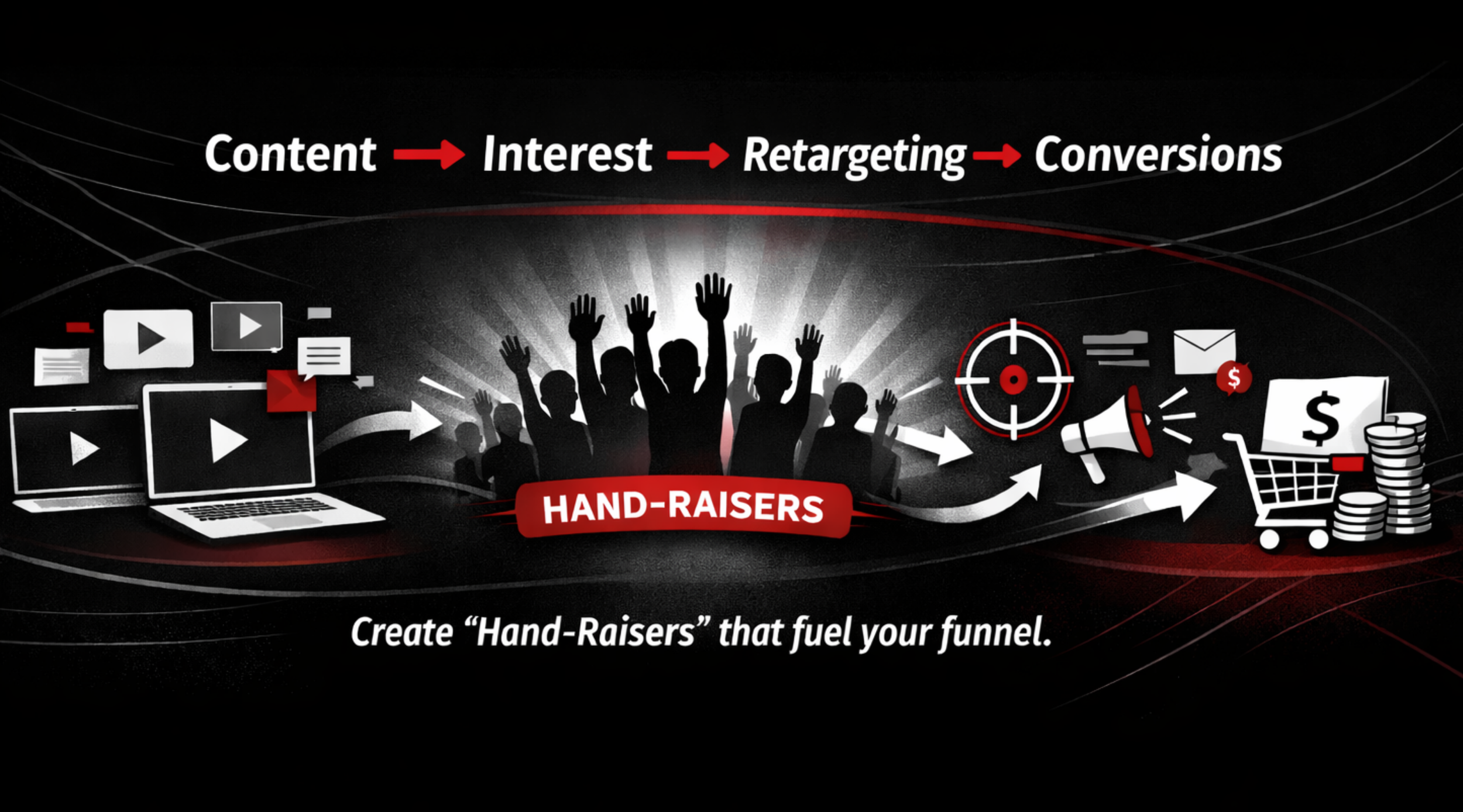
If someone drives by your billboard, even if they were interested, you have no opportunity to know that and deliver a follow up, intentional message to them.
Duolingo is the modern masterclass in this bridge
If you want a best-in-class example of connecting top-of-funnel attention to revenue, Duolingo is sitting right there in public.
Their “unhinged” content is the high-volume engine of the acquisition loop, and their performance marketing stack is the closer that converts that attention into high-LTV subscriptions.
And the thesis is simple: A “social-first” brand identity, when backed by rigorous performance marketing and product-led growth, can redefine CAC and revenue growth.
And the numbers to back that thesis up are stunning. Here’s just one: Duolingo’s TikTok strategy generated 376.4 million views between December 2023 and February 2024—and in Q1 2024 their revenue was up 45% YoY.
This is exactly the point most businesses miss:
Duolingo’s social doesn’t “sell.”
It creates attention, interest, and brand gravity…
…and then the conversion engine does its job.
I Asked for Attention, and We Got Season Ticket Buyers
When I worked with the Falcons, we had an incredibly talented video production team, led by Austin Hittel and Chris Wenk.
Selling season tickets was a major priority. And our video team was a big part of the digital strategy for helping tackle that priority.
But I never asked them to produce season ticket ads.
I asked them to keep making content people actually wanted to watch.
Then we:
Put a small awareness budget behind the best-performing videos (to earn more attention, not push a CTA)
Built retargeting audiences from video viewers and site visitors
Let paid media retargeting do the “ask”
Those massive retargeting audiences became our highest-performing ad sets… inside an overall effort that drove 17:1 ROAS.
That’s the model in one story:
Content earns attention. Performance marketing converts attention.
A practical playbook for leaders who want this connected
If you want to connect awareness to conversion without playing attribution roulette, build the system like this:
1) Stop judging content by last-click conversion or direct revenue attribution
2) Judge top-of-funnel by “interest creation”
Track:
video views (especially 10s/ThruPlay)
engaged sessions on site (time, scroll, repeat visits)
growth of retargeting pools
3) Build retargeting and nurture like a “second act”
4) Use the conversion engine to validate the awareness engine
Next:
If you’re running “all the right plays” but nobody can agree on what top-of-funnel is actually doing, that’s usually not a talent problem.
It’s a systems problem.
I help teams build an insight-first content engine that connects earned attention → measurable interest → performance marketing → revenue, without forcing content to act like an ad.
If you want help designing this for your business (and building the measurement that reduces the budget anxiety), reach out—and let’s talk.
