
Marketing FOMO Is Your Biggest Marketing Problem
As soon as I saw it, I literally stood up from my chair in the middle of a coffee shop.
I had been sitting there reading Greg McKeown’s excellent book Essentialism when I saw the simplest, most powerful graphic I can ever remember seeing.
It looked like it was hand drawn, took no design skills whatsoever… but it fired every synapse in my brain at the same time.
Because it communicated something I had spent years trying to explain:
Trying to do everything gets you nowhere. Clear direction and focus moves you forward.
Most marketing departments live in the left side of this graphic.
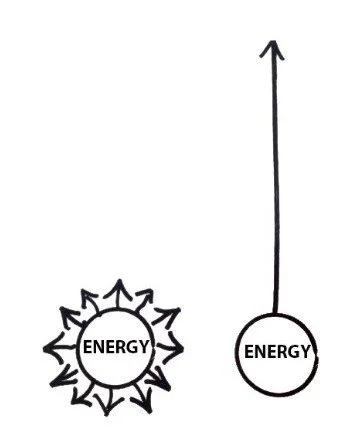
The simplest, most powerful business graphic. From Essentialism, by Greg McKeown
Marketing FOMO is the default operating system
Marketing FOMO is that pervasive feeling that we should be doing everything:
“What are we doing for ________ Day?”
“Why aren’t we doing a press release for this initiative?”
“Can we do a video for _________ event we’re hosting?”
“Did you see that _______ just happened? What should we post?”
“Brand X posted this _______ can we do something like that?”
It’s rarely asked if those deliverables will have a measurable impact on business KPIs, goals or our consumers.
Instead, the unspoken goal becomes: Let’s do everything!
But presence, or simply publishing, isn’t a strategy.
And it quietly creates the same outcome over and over:
A team that’s overworked, spread thin, and stuck producing “a lot”… with very little to show for it.
The hidden reason Marketing FOMO keeps winning
The reason Marketing FOMO is so common isn’t necessarily because marketing leaders are undisciplined. Although that can certainly be true too.
It’s more likely because marketing is public.
Everyone sees it. Everyone has opinions. Everyone has ideas. And let’s be honest, it’s more fun to think about than something like Legal or Finance. So, in a lot of organizations, marketing unintentionally becomes an internal service desk:
Requests come in
Marketing responds
Output increases
Impact doesn’t
That’s why I think this is one of the most important questions a marketing leader can answer:
Is marketing an internal service agent… or a strategic driver of business impact?
Because if you don’t define the answer, the organization will define it for you.
Greg McKeown says it bluntly in Essentialism: “If you don’t prioritize your life, someone else will.”
Marketing teams feel that exact pressure — except the word “life” is replaced with “strategy.”
The fix isn’t “doing less.” It’s deciding better.
A lot of teams interpret focus as a mindset problem:
“We just need to say no more.”
But “no” is hard when you don’t have decision criteria.
So here’s the real shift:
Stop asking: “Can we do it?”
Start asking: “What should we do, and why?”
That’s the entire game.
And it requires a shared filter.
McKeown describes an “essential intent” as “one decision that settles one thousand later decisions.”
That’s exactly what marketing needs: fewer, clearer decisions that prevent a thousand reactive tasks.
My favorite filter for this: ROTI (Return on Time Investment)
Perhaps the most important factor marketing leaders should be evaluating every day is something I call ROTI: Return on Time Invested.
Because time is the one resource you never get more of, and marketing waste is usually time waste.
ROTI is the simplest way I know to force the right trade-offs.
When a new request pops up, ROTI asks:
What business KPI is this expected to move?
(Demand, leads, conversion rate, revenue, retention, LTV, etc.)What’s the mechanism?
How, specifically, does this deliverable change customer behavior?What’s the opportunity cost?
What high-impact work gets delayed, reduced, or watered down if we say yes?What will we measure?
If we can’t define success upfront, it’s probably not a priority, it’s just noise.
ROTI doesn’t mean you never do “brand” work, cultural moments, or community content.
It means you stop doing them by default.
A simple “FOMO Audit” you can run this week
If you want to reduce FOMO-driven work fast, do this with your team:
Step 1: List your next 30 days of deliverables.
Everything.
Step 2: Put each item into one of three buckets:
Revenue-driving (directly tied to leads/sales/conversion)
Perception-driving (clearly improves how people think/feel, with a measurable proxy)
Noise (requested because “we should,” “we always do,” or “someone asked”)
Step 3: Pick your “vital few.”
The 3–5 things that actually deserve the best creative energy you have.
This is where most teams get stuck — because cutting work can feel political.
Which brings us back to the core leadership job:
Protect the vital few.
The downstream effect nobody talks about
Marketing FOMO doesn’t just reduce performance.
It erodes culture.
Because the downstream effect is always the same:
Creatives spend time on low-impact work
The best ideas get rushed. Or abandoned because they can’t be executed correctly
The team learns that excellence isn’t the expectation, speed and volume are
Eventually, “good enough” becomes the standard
And one thing that not enough people talk about: Creative cultures dwindle because big ideas are no longer exciting. They’re dreaded because they’re just viewed as more work on the plate in an environment where the organization doesn’t know how to prioritize.
The real goal: a few strategic pillars, executed with force
The right marketing strategy isn’t “more content” or “more campaigns.”
It’s a set of focused strategic efforts that complement each other, and that you can execute at a level that actually earns attention, creates demand, and drives action.
The graphic that got me out of my chair wasn’t just a drawing.
It was a warning.
Most teams don’t lose because they lack talent.
They lose because they spend their talent everywhere.
Energy in all directions stays put.
Energy in one direction creates outcomes.
Next:
If your team is drowning in requests, scattered execution, and calendar-driven “shoulds,” I help marketing leaders build:
clear decision criteria (ROTI),
focused planning around “vital few” initiatives,
and an operating system that ties work to measurable impact.
Let’s talk.
