
What If Your Marketing Team Was Built to Produce Big Ideas, Consistently? (pt. 1)
Your heart is racing. But time is a glacier.
Hours later, jubilation and team celebration.
That contrast typically sandwiches the moment a big idea launches.
Those moments can:
-Define an entire year.
-Shape the perception of a business
-Become shared experiences that bond teams and departments.
What if we could do that more often?
“Nothing is more powerful than an idea whose time has come.” Famous writer Victor Hugo once said.
And advertising great George Lois, defined it in practical terms: “Creativity can solve almost any problem. The creative act, the defeat of habit by originality, overcomes everything.”
Big ideas and breaking through the noise are more important than ever in today’s algorithmic landscape that has become a ‘street fight for attention’.
The Law of the Vital Few (and why it matters more now)
The “Law of the Vital Few”, also known as the Pareto Principle, tells us that 80 percent of results come from 20 percent of efforts.
I think that ratio is 90/10 in marketing today.
You don’t have to dig too far to verify that. How many impressions did your top Instagram post get in 2025? How many did the bottom 20 get, combined?
How much time did your team spend on the bottom 20?
So, here’s the real question:
Are your best people spending their best energy on the vital few, or on the urgent many?
In Tuesday’s post, I said marketing can become a support mechanism for internal initiatives or ideas with no measurable impact on goals instead of larger strategic outcomes.
And the downstream effect is brutal, not just for performance, but for culture:
Creatives spend time on low-impact work
The best ideas get rushed or abandoned
Speed and volume become the expectation the standard
And eventually big ideas stop being exciting… and start being dreaded by a team that doesn’t want to think about having to execute them
That’s the true cost of FOMO. You stop creating the kind of work that can actually change what people think and feel.
Here’s the “what if” every organization should get excited about:
What if your team had the space to make work that:
Earns real attention
Changes perception
Creates pride inside the building
Energizes and engages your team at a higher level
That’s not fluff.
It’s a leadership and operations decision.
Big ideas don’t need more pressure.
They need better conditions.
How to operationalize big ideas
This is the part leaders want: What do we actually do Monday morning?
Here’s the system.
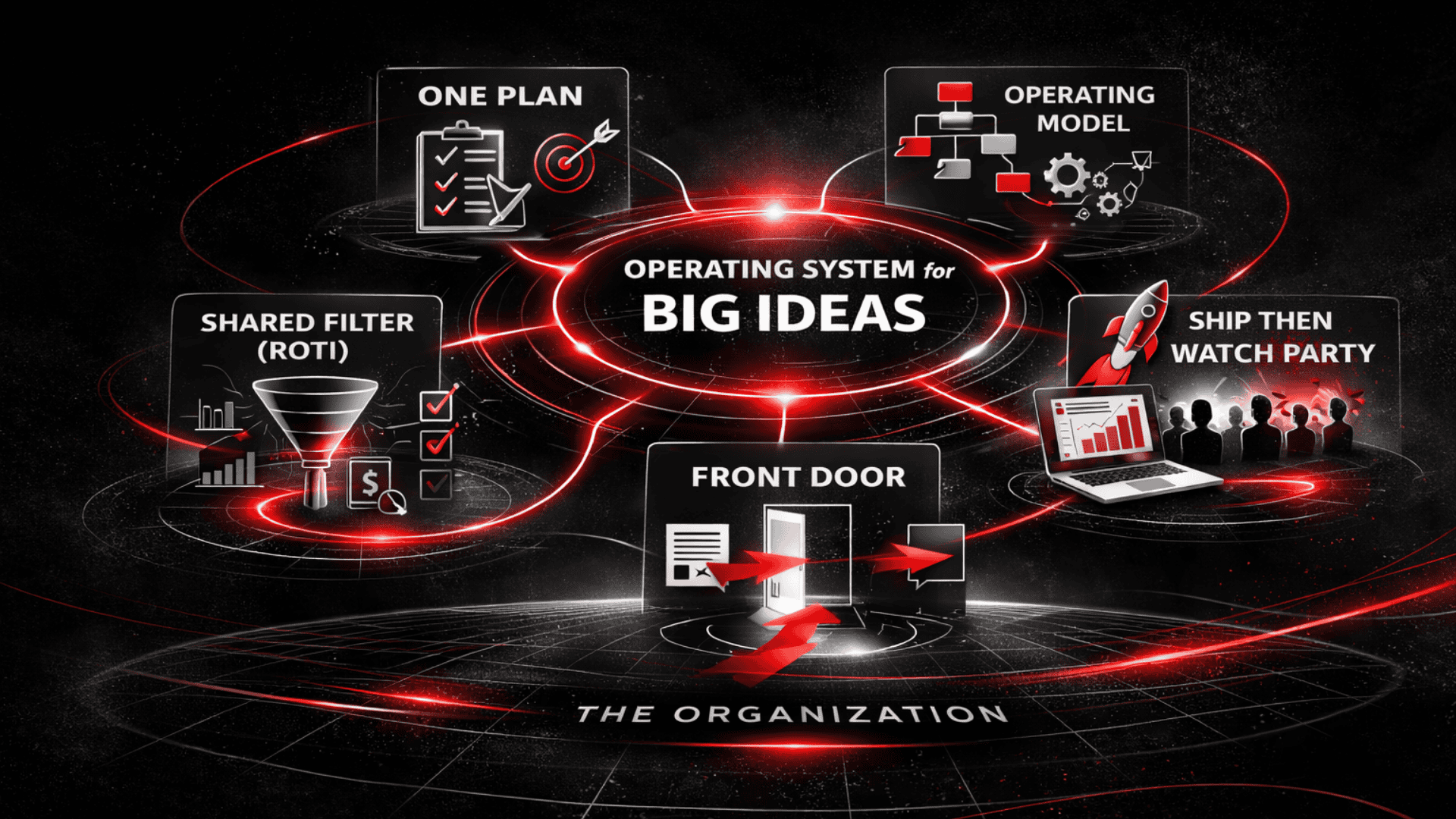
1) Make “one plan” the law of the land
Big ideas can’t survive if there are five different “priority lists” floating around.
You need one annual plan the organization recognizes as the plan.
That plan needs to lay out the Goals and KPIs that crystalize what types of efforts the team will undertake throughout the year. And the types that don’t measure up to that.
That plan also needs to outline the biggest opportunities that can be foreseen that year, and the framework of how they are going to succeed in those opportunities.
And based on that, the plan should call out ‘Heavy Execution’ periods where pencils are down, and new activations take a backseat.
Because the moment priorities are unclear, “priority of the urgent” wins by default.
And yes — that means some stakeholders are going to hear “not now.” But that should be the expectation coming out of the organizations annual plan, with defined ‘heavy execution’ periods.
Stop re-litigating priorities every week.
Make fewer decisions that settle a thousand later decisions.
2) An Operating Model that blocks for creatives
This is one of the most important (and most misunderstood) pillars: Don’t confuse “creatives sitting in meetings all day” with collaboration.
Keep creatives creating.
The operating model has to shift meeting load and coordination away from creators.
Project Managers and/or Marketing Operations need to manage expectations, prioritize projects by impact, attend the bulk of meetings, and “block” for creative and content teams so they can spend most of their time on creativity and execution.
3) Stop giving significant feedback before work is published
If the vision is communicated clearly, the insights that drive performance are known, and the team is bought in to try to move your audiences…
Pre-approval culture is where big ideas go to die, and creative culture crumbles.
Not because leaders are bad people. But they often optimize for:
Safety
Consensus (often cross functional)
Consistency (brand standards)
What won’t get them in trouble
And really, pre-approval before we know how our audiences react largely comes down to personal preference and opinion, not actual results or impact on audience.
A better rhythm: ship faster, then review performance together, once we have real results and can talk through why it was, or was not, successful.
The “Watch Party” concept is one of my favorites because it changes everything about feedback. Order in lunch, bring the numbers, and talk as a group why certain things worked, and others didn’t. Get everyone talking in terms of performance (instead of personal preference), and WHY people did or did not react the way you expected them to.
Creatives can accept after-action feedback more easily when it’s framed through outcomes and results, instead of opinion.
And you reduce the approval drag that slows everything down.
And I’ve seen that this approach is FAR better for creative culture because it increases the sense of empowerment, while morale goes down when work gets shot down due to opinions.
4) Put a real front door on requests
One of the biggest practical problems in marketing is “drive-by prioritization.”
Slack pings. Side conversations. A quick “can you just…” after a meeting.
So: build a front door.
Everything comes through one intake path, with a few mandatory fields:
-What are we trying to accomplish?
-When do you need it?
-Who owns the decision?
… And I love these two:
-Who is the audience?
-Why will they be interested in this?
5) Use a shared filter — publicly
In Tuesday’s post, I outlined the Return On Time Investment (ROTI) filter I love because it forces adult conversations fast:
What business KPI is this expected to move?
What’s the mechanism?
What’s the opportunity cost?
What will we measure?
That “opportunity cost” question is the whole ballgame, because it makes the hidden tradeoff explicit:
If we say yes to this, what high-impact work gets delayed, reduced, or watered down?
Protect the vital few. Not with slogans.With a shared decision system.
Today, I’ve addressed building a culture where big ideas can thrive from an organizational standpoint. Tomorrow, I will do a part 2 that looks at how to ensure the right factors are in place for your team to consistently come up with great ideas.
