
What If Your Marketing Team Was Built to Produce Big Ideas, Consistently? (pt. 2)
Yesterday I wrote about the operating system that makes big ideas possible: one plan, blocked creative time, fewer approvals, a central intake system for requests, and a ROTI (Return on Time Investment) filter that forces tradeoffs.
Today we’re going to talk about what’s possible once the organization is on board. .
Even with a perfect organizational operating model, big ideas in marketing still die or don’t surface for one simple reason:
Lack of a creative culture and synergy within the department.
Project Aristotle and the Google Question That Unlocked Creative Culture
Google spent years trying to answer: Why do some teams outperform others, even when the “talent” looks the same?
They studied hundreds of teams and measured everything from performance to team satisfaction.
The surprising conclusion wasn’t “hire better people.”
The breakthrough came when they realized the highest performing teams shared one metric: “Equality in distribution of conversational turn-taking”
It was less about who is on the team, and more about how the team works together.
More participation from more people on the team means:
More people sharing more ideas, and (more importantly)...
More building onto those ideas, with more thinking from other perspectives/experiences
So what is the takeaway for leaders who want to foster a creative culture among a team?
Google found psychological safety was the #1 predictor of team effectiveness.
Basically, do the members of the team feel supported and that they can share without being negatively judged?
Equal talk time doesn’t matter because it’s “fair.” It matters because it signals a few deeper things are true:
People believe they can speak without getting punished.
People believe their input matters.
The group isn’t optimized for hierarchy, it’s optimized toward achieving something together.
So let’s bring Project Aristotle to life through the lens I use to evaluate and instill creative culture.
Below are six factors I’ve found critical to fostering a creative, collaborative environment. An environment where the best, not the loudest, idea wins.
Factors of a Creative Culture
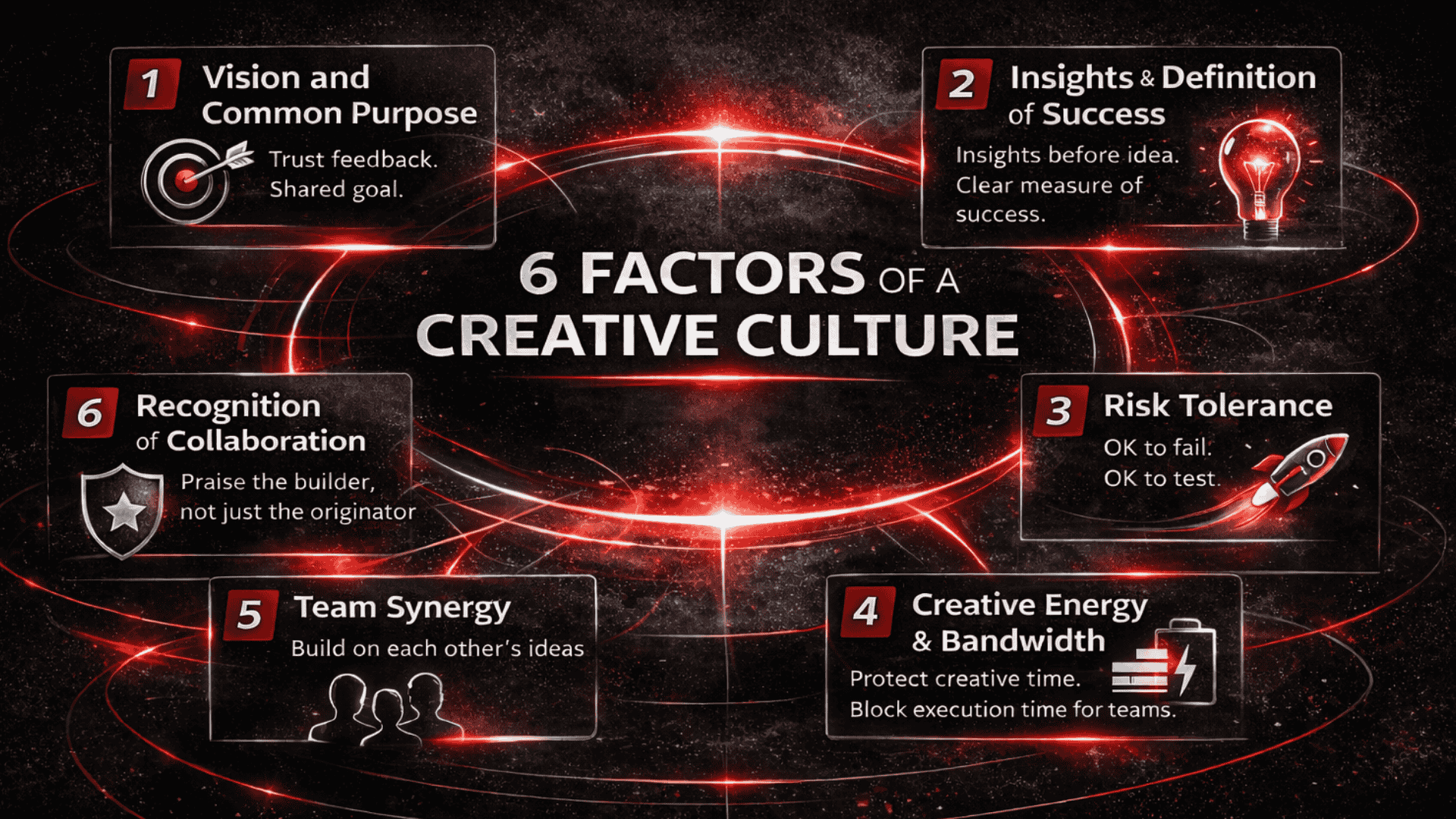
1) Vision and Common Purpose
High-performing teams don’t just work with each other. They work toward something together. Something bigger than any one of them could achieve alone.
When the vision is clear and shared:
Feedback stops feeling personal (“I don’t like that”)
And starts feeling directional (“Will this help us achieve what we said matters?”)
This is a quiet reason equal talk time becomes possible:
When people trust the purpose, they’re less defensive. They know that feedback is aimed at reaching a shared goal, not a personal judgement on the individual.
2) Insights and Clear Definition of Success
Creativity thrives inside clarity.
In creative teams, that translates to: Collaboration breaks down if everyone has a different definition of what “good” is.
Project Aristotle showed that teams perform when they have structure and clarity, and people know what’s expected and how success is measured.
Leader move:
Make the brief sacred. Keep it short, but specific:
Who is the audience?
What do we know about them (insight)?
What do we want them to think/feel/do?
How will we know we succeeded?
When success is clear, people can build on each other’s ideas instead of arguing about the target.
3) Risk tolerance
Here’s the truth: No one takes big swing at ideation if safety is the rule.
You’re not just pitching a concept.
You’re exposing taste. Judgment. Instinct. Creativity.
Project Aristotle’s headline finding (psychological safety) matters because creativity is basically a series of risks:
“This might not get the reaction we want… but what if it’s great?”
“This might not be on-brand… but what if it’s the breakthrough?”
“This might fail… but what if it teaches us something valuable?”
Leader move:
Normalize learning language:
“We’re going to test this.”
“We’re going to find out.”
“We’re allowed to take swings.”
That doesn’t mean having a total lack of judgement. Every team should have guardrails. But they don’t have to be applied during the ideation stage.
And the only permanent damage to creative culture happens when people lose the motivation to bring ideas to the table.
4) Creative Energy and Bandwidth
Even the most talented creative team can’t produce breakthroughs if they’re exhausted.
Project Aristotle found that chaos kills performance. Same for creative output.
If big ideas are always stacked on top of a full calendar, they stop feeling exciting and start feeling like a burden.
Leader move:
Protect energy like it’s a resource your business runs on—because it is.
Block for creatives to have time to be creative.
Reduce meetings for people that don’t need to be in them It’s not inclusive, it’s draining..
Build “heavy execution” periods where new asks and activations are de-prioritized.
Creative culture isn’t just vibes. It’s time, space, and standards.
5) Team Synergy
Synergy is what happens when a team walks into a room, and the energy that goes into the idea or solution they come up with is greater than the sum of their individual energies before they walked into the room.
Synergy is the feeling that:
“If I share an idea, the room will build it up, not tear it down.
“We’re on the same side.”
“The goal is the best outcome, not who ‘wins’ the meeting, or gets credit for the idea.”
Project Aristotle’s equal talk-time insight fits perfectly here: When one voice dominates, people disengage. And when people disengage, collaboration collapses.
Hall of Fame basketball John Wooden defined a great teammate as someone who was not just ‘willing’, but ‘eager’ to help those around them.
Build that, and you’ll have team synergy.
6) Recognition of Collaboration
Most companies accidentally reward the wrong thing. They celebrate the person who had the first idea.
They don’t celebrate the people who made it better.
If you want real collaboration, you have to reward the behavior you want repeated: building on the ideas of others.
Leader move:
In public, praise additions:
“The best part of this idea was what you added.”
“That piece that ______ added took this concept to the next level.”
“You took something good and made it great.”
The greatest executions usually happen when you have a team of people that feel ownership of the concept, instead of an individual.
The brainstorm method that makes equal talk time real
If you want “Equality in distribution of conversational turn-taking,” you can’t just ask for it.
You have to design for it.
Here’s the 3-step brainstorm process I’ve used for years when I wanted more ideas from more people, especially when some of the most creative minds went quiet in group settings:
Step 1: Dedicated time to think
Give the team a brief (insights + who the audience is + what success looks like).
Then tell everyone to block real time (ex: two hours) away from Slack/email.
Walk. Music. Inspiration rabbit holes. Whatever gets them into a creative zone.
In most organizations, time to be creative is the most underestimated, least planned for use of time. Want big ideas? Block time to be creative.
Step 2: Record and prepare ideas
Everyone writes down everything.
Then picks their best three ideas and writes each as a simple Creative Idea Statement they can present clearly.
Step 3: Present and vote
Regroup a day or two later.
Each person presents their three ideas. And each idea goes on the wall (sticky note).
Now give everyone a pen, and have them go to the wall in small groups. Everyone uses their pen to add a vote for their top three ‘sticky note ideas’.
Now you’re not debating personalities. You’re selecting ideas.
And the best part: when the top 3 vote getters emerge, you do the real brainstorm, together, building onto each idea as a group.
The energy changes because the idea isn’t “mine” anymore.
It’s “ours”.
The punchline
Project Aristotle didn’t just teach us what makes teams “nice.”
It taught us what makes teams effective.
And for creative teams, effectiveness starts with a simple, visible truth: The room belongs to everyone.
When you build a culture where people know feedback is aimed at moving closer to a goal, collaboration is rewarded, and energy is protected…
Big ideas stop being rare.
They start becoming what your team does.
Next Step:
If you want help designing this inside your org—team culture + operating system—reach out. I help leadership teams build the rituals, decision systems, and creative conditions that make big ideas repeatable.
