
Everything Has Changed About Marketing… Except Your Creative Process
What I was hearing made no sense.
I’d just left the Chicago Bears, where I lived in digital strategy and content production, to join a PR agency (Taylor Global) that was building out its digital practice. My first three clients were Allstate, Capital One, and Tide.
These brands were surrounded by a full suite of creative agencies, paid media agencies, and PR teams. And they were all racing to “guide” them through the rise of digital and social.
And almost all of that guidance had the same fatal flaw:
They didn’t understand the difference between content (built to earn attention) and advertising (built to push a message).
They could see the media landscape changing… but their creative process was still frozen in the golden age of television. The questions used to kickoff creative outcomes were all variations of these:
“What’s our brand message?”
“What’s our value proposition?”
“What’s on our business calendar?”
“Is this aligned with the brand campaign?”
On the agency side, everything (quietly) revolved around one question:
“What will the brand approve?”
Meanwhile, almost no meaningful thought was given to the only question that determines whether anything wins in today’s landscape:
Why will anyone care?
Since then, the world has only become more personalized, and more ruthless for marketers.
Platforms distribute based on relevance.
Email providers filter what people ignore. Streaming platforms win because their recommendation engines keep serving more of what holds your attention. And TikTok’s “For You” rewired expectations for every feed on earth.
There are very few ways to reach people at scale anymore if you’re not built to be relevant.
Marketing has changed. Most creative processes didn’t.
The real shift isn’t “better creative.” It’s a mindset shift.
Most organizations talk about “getting better at content.” Or posting more of it.
But the real unlock is more foundational than that:
Creating consistent results isn’t just a creative process improvement. It’s a mindset shift.
The old mindset assumes:
You can start with what the brand wants to say
Then wrap it in “creative”
Then buy distribution
That’s the TV-era operating system. Now, your creative has to earn it’s own audience. It has to capture interest.
Distribution is earned.
So the inputs have to change.
That’s why I love this simple framework (and why it’s so challenging in real organizations):
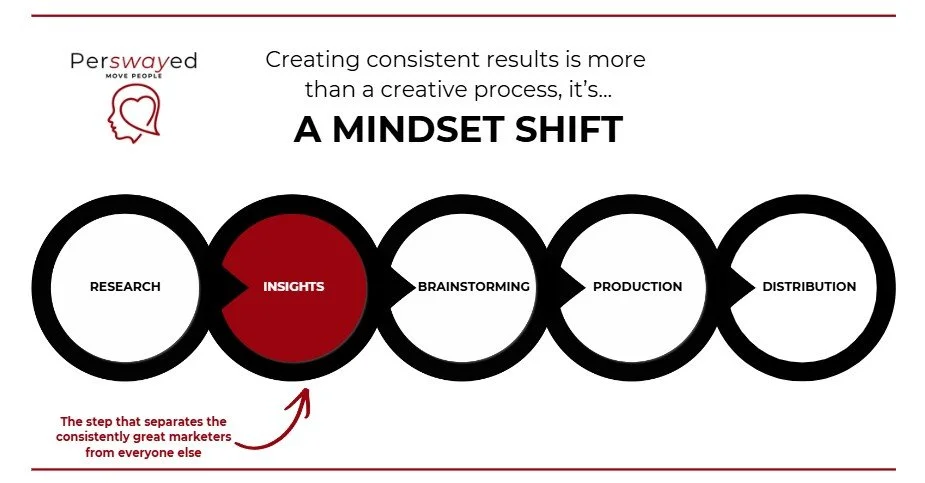
I’m going to reference it throughout this post because it’s the simplest, most consistent path I’ve found for whether a team is actually built for relevance.
And there’s one step in that chain that separates consistently great marketers from everyone else:
INSIGHTS.
Not “insights” like generic stats and demographic breakdowns.
Real insights: the human stuff.
The stuff that actually makes people react.
Emotion. Motivations. Interests. Decision criteria. Identity. Tension.
What makes their hearts beat faster?
TV-era creative inputs die in algorithms
The legacy creative process was built for one world:
A world where distribution was guaranteed.
If you could pay for reach, then the job of creative was mostly to communicate the message clearly, and fit the product calendar.
So briefs became centered around internal priorities:
message
equity
tagline
campaign calendar
approvals
They produce content that looks like what it is: advertising.
And algorithms are designed to deprioritize anything people scroll past.
In other words:
If your inputs are brand-first, your output will be skippable.
A better fit for today: Research → Insights → Brainstorming → Production → Distribution
Let’s walk through the process you’re going to include in the post—and why it’s the “simple but hard” shift teams need to make.
1) Research: you don’t earn relevance by guessing
Research isn’t a one-time exercise. It’s a permanent discipline.
It answers:
What are people reacting to?
What are they frustrated by?
What do they want to become?
What language do they use when they talk about this without a brand in the room?
Useful research sources (because they contain truth, not theory):
Comments, replies, and DMs
Past content performance (what caused reaction, not just impressions)
Search volume
Sales objections and call notes
Most importantly: Are your creatives curious? When their work is published, are they evaluating how well it resonated? If it generated reactions and reach?
You want content creators on your team, not artists. Artists create work they like. Content creators know they’re responsible for capturing the attention of an audience.
2) Insights: the step that creates consistent results
Real acceleration happens when your business goes from just knowing what the data says, to why.
Insights are the bridge between what people do to why they do it.
And this is the mindset shift most organizations avoid, because it requires humility:
The audience doesn’t owe you attention. You have to earn it by understanding them. Insights are emotions and motivations, not demographics.
And if you can understand their why, and effectively brainstorm and scale ideas that effectively hit their why… well now you’re on to something.
3) Brainstorming: ideas should be downstream of insight
Most brainstorming sessions fail because they’re trying to generate ideas without fuel.
It turns into:
“What if we did a video…?”
“What if we made a carousel…?”
“What if we did a giveaway…?”
Those aren’t content ideas or concepts. They’re formats.
When brainstorming comes after insight, it becomes:
“How do we dramatize this tension?”
“How do we say the thing everyone feels but no one says?”
“What story proves this is true? And how do we make them feel it is their story?”
Now you’re generating ideas that have a reason to exist.
4) Production: protect creative energy, don’t smother it
Production is where good ideas get watered down.
Not because teams are incompetent.
Because approvals often optimize for:
brand safety
internal consensus
“it’s safe”
Boring is not a good content strategy.
The mindset shift here is simple:
You can’t approve your way into relevance.
5) Distribution: the reward for relevance (and the engine for results)
Distribution is no longer something you “do to” content.
It’s something you earn.
And when you earn it, something powerful happens:
Great content doesn’t just create awareness. It makes every form of performance marketing easier.
When someone watches, clicks, comments, saves, or shares… they raise their hand. They’ve indicated interest.
Those hand-raisers become the most valuable asset in modern marketing:
Retargeting audiences
Email nurture segments
Lead scoring inputs
Future lookalikes
Insight feedback loops
All of a sudden, your Cost Per Acquistion in paid media campaigns begins to plummet. That’s how relevance turns into results.
The simplest diagnostic: where does your process actually start?
Most teams say they do research.
But their real starting point is:
the calendar
the product launch
the weekly meeting
the approvals chain
Which means they skip directly to brainstorming and production…
…without the insight step that makes content worth consuming.
So here’s the honest question:
Are you running a content process… or a publishing process?
Publishing processes create volume.
Insight-led processes create impact.
A practical upgrade: rewrite your brief in one line
Replace:
“What’s our message?”
With:
“What’s the insight we’re earning attention with?”
Then force the team to answer:
What emotion are we aiming to trigger?
What tension are we resolving?
What identity are we affirming?
What will make someone say: “That’s me”?
If you can’t answer those questions, don’t produce.
Not because you’re being precious.
Because the platform won’t distribute it anyway.
Next Step: Want help making this mindset shift real inside your organization?
If your team is doing “all the right things” but content isn’t earning attention—and paid media feels like it gets more expensive every quarter, the bottleneck usually isn’t effort.
It’s the operating system.
I help teams implement an insight-first content engine that connects:
Research → Insights → Creative → Distribution
If you want to rebuild your creative process for relevance (and results) consistently, reach out and let’s talk.
